
AT&T, Verizon, and other carriers will start to launch 5G networks this year. But what exactly is 5G, and how fast is it compared with 4G? Here are the facts we know so far.
5G Is Real
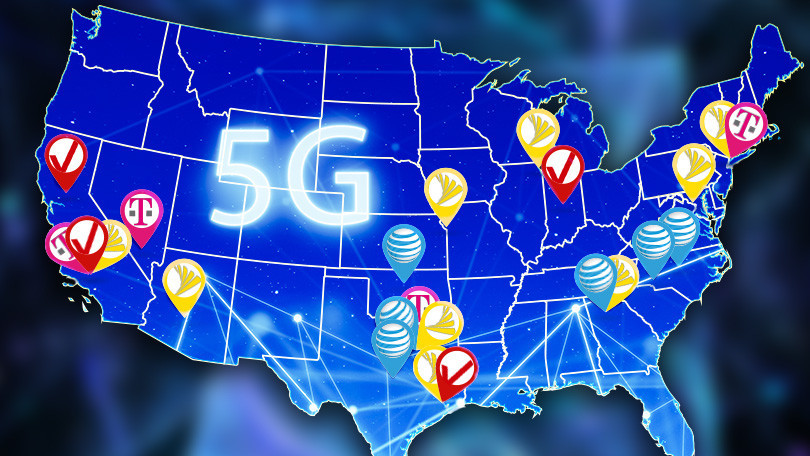
Verizon Wireless has won the race to 5G—sort of. On October 1, Verizon launched its “5G” home service in Houston, Indianapolis, Los Angeles, and Sacramento, establishing equivocal bragging rights and setting off a domino run of 5G network launches that will continue through next spring.
That first network isn’t actually the real, global mobile standard for 5G. The first one of those will likely be AT&T’s network, coming by the end of the year. (Verizon plans to switch to the global standard next year, swapping out equipment at no cost to existing customers.) This all means you’re about to see the marketing for 5G get ramped up quite a lot, and so it’s good to know what everyone’s actually talking about.
5G stands for fifth-generation cellular wireless, and the initial standards for it were set at the end of 2017. But a standard doesn’t mean that all 5G will work the same—or that we even know what applications 5G will enable. There will be slow but responsive 5G, and fast 5G with limited coverage. Let us take you down the 5G rabbit hole to give you a picture of what the upcoming 5G world will be like.
How 5G Works
Like other cellular networks, 5G networks use a system of cell sites that divide their territory into sectors and send encoded data through radio waves. Each cell site must be connected to a network backbone, whether through a wired or wireless backhaul connection.
5G networks will use a type of encoding called OFDM, which is similar to the encoding that 4G LTE uses. The air interface will be designed for much lower latency and greater flexibility than LTE, though.
5G networks need to be much smarter than previous systems, as they’re juggling many more, smaller cells that can change size and shape. But even with existing macro cells, Qualcomm says 5G will be able to boost capacity by four times over current systems by leveraging wider bandwidths and advanced antenna technologies.
The goal is to have far higher speeds available, and far higher capacity per sector, at far lower latency than 4G. The standards bodies involved are aiming at 20Gbps speeds and 1ms latency, at which point very interesting things begin to happen.
Who’s Launching 5G? When?
AT&T has proclaimed that it will be first with mobile 5G when it launches a network in 19 cities by the end of this year. The company has listed its 19 cities and says that initially there will be one 5G device, a mobile internet hotspot potentially called the Netgear Nighthawk M5 Fusion that we saw at a Qualcomm event in December. Phones will come next year. AT&T will use 39GHz spectrum for its initial rollout, followed by some 28GHz, and then low band, former 3G spectrum later in the year.
Verizon is starting out with its fixed 5G home internet service, which is now available. It will follow with a mobile 5G network in 2019, the carrier has said. The carrier is mostly using 28GHz spectrum.
Which 5G Phones Are Coming Out?
The first round of 5G phones will only support some of the 5G systems being used in the US. They will not support low-band, FDD networks, such as T-Mobile’s 600MHz and AT&T’s old 3G spectrum. So if broad 5G coverage is more important to you than top speeds in urban areas, you may want to wait for phones that support those networks during the second half of the year.
Samsung has pledged an early flagship phone, probably the Samsung Galaxy S10, for AT&T, Verizon, and possibly Sprint. This will probably be announced in February and become available in March. The company has also said it will release a second 5G phone for AT&T’s broader low-band network during the second half of the year.
Sprint has said an integrated 4G/5G Android phone from LG will come to its network during the “first half of 2019.”
Verizon’s first 5G phone could be the existing Moto Z3, which has a 5G add-on promised for early next year.
Many other companies, including OnePlus, ZTE, Oppo, Vivo, and Xiaomi, have pledged to produce 5G phones in 2019. But it’s not clear if any of those will come to the US, as the first round of 5G phones are likely to be carrier-specific.
We think there will be a 5G iPhone in 2020, but not before.
 FlashIT